Overview
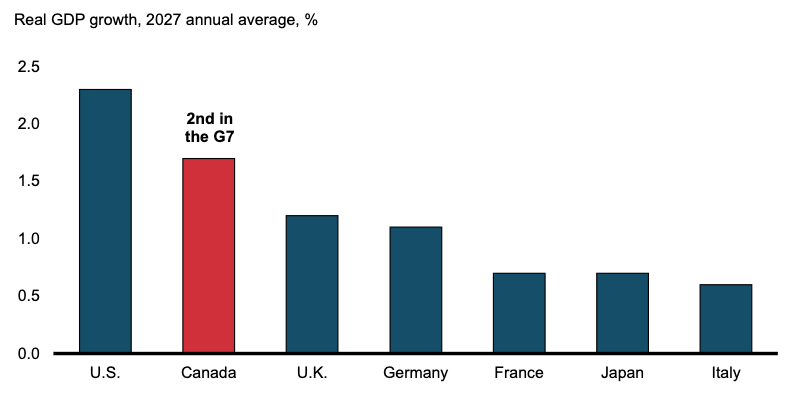
The Canadian economy is currently growing at 1.1% but the IMF expect this to rise to 1.7% in 2027. This would be the 2nd highest growth rate among the G7.
An OECD briefing note points out that the trade-related slowdown prompted by US tariffs should give way to the beneficial impact for energy related exports (see here). The unemployment rate is 6.5% which is consistent with a long term average and below the annual rate for 2025 and 2026.
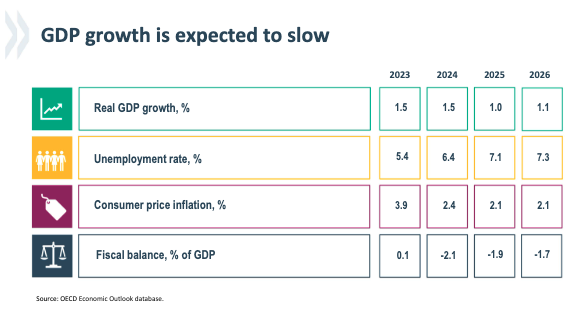
Source: OECD Economic Survey
Monetary policy
The monetary authority is the Bank of Canada and their objective is to keep inflation close to a 2% midpoint within a 1-3% band (source). The governor is Tiff Macklem, whose 7 year term will end next year.
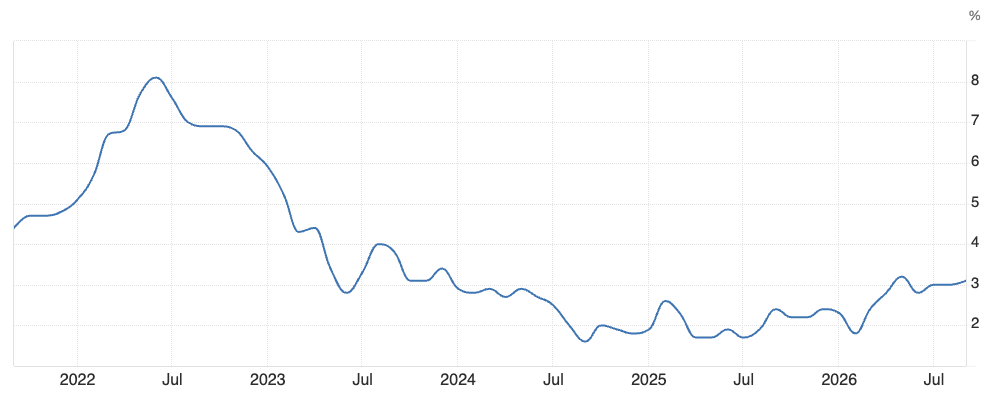
The current inflation rate is 3.1% which is outside this band and reflects a slight uptick from previous years. The OECD expect this to fall back to target, so while it is under control it needs to be monitored closely.
The current policy rate is 2.5% and a simplified Taylor Rule suggests it should be 5.65%, indicating loose monetary policy.
Fiscal policy
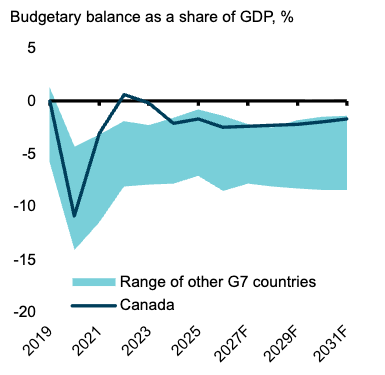
François-Philippe Champagne has been Finance Minister since March 2025 and Canada does not have any binding fiscal rules. The budget deficit is running at -2.1% which is half as much as compared to the previous year.
The most recent budget report boasted that:
Canada is now positioned to balance operating spending with revenues one year ahead of schedule, by 2027-28.
There is a very limited case for any fiscal stimulus - as of 2025 a rough estimate of the multiplier range (using this bucket method) was 0.4-1.0 and the current output gap is fairly low. Morgan Stanley estimate potential growth (Y*) to be around 1.5% and rising.
Public debt is expected to be 40.2% in 2026 and is expected to however around 40% through 2031. This demonstrates that public debt is extremely manageable.
Conclusion
The Canadian economy looks well managed and resilient. It is dependent on US trade and energy exports which makes it reliant on favourable external conditions, but AD is stable and close to the long term trend.
A note on sources:
For a snapshot of current data see The Economist.
For projections see the IMF’s World Economic Outlook.
For detailed analysis see the OECD’s Country Notes.
